

ADDAC511 VC STOCHASTIC VOLTAGE GENERATOR - ADDAC System
by Ellison Wolf
After talking with Andre Gonçalves of ADDAC System, it became 100% crystal clear how much he and his company love unpredictability when it comes to voltage changes across a modular system; it is their lifeblood. Not content with basic CV manipulation, they've crafted the 511 Stochastic Voltage Generator (an update to their ADDAC501 Complex Random from over a decade ago), that lets you tweak all of the nooks and crannies you could possible desire across four channels of random voltage generation. You can control/determine things like quantization, clock, waveshape, probability, create up to thirty-two steps of a sequence per channel, and much more. Random predictability has never seen so much control!
When I first got a hold of ADDAC511, I thought it was an excellent choice for something I'd longed for for a while to use throughout various stages in a small to medium sized setup; a module that could be part sequencer, part modulator. Sometimes in a small travel setup I'll use an S&H module as a rudimentary sequencer in order to generate note changes on a sound source, and it works ok…at first. Eventually, I always come to the same problem that even a great 2 Hp S&H still needs a clock source, usually doesn't have a gate output, etc., so any space I think I'm saving, I'm really not. I have used ALM's Pam's Workout with some success, but it doesn't have bipolar modulation and using it for anything other than basic sequences is limited—through no fault of it's own.
With four channels available 511 works incredible on many different levels, though one (of which I'll get to later) leaves something to be desired; though like Pam's, through no fault of its own.
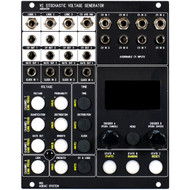
Each channel is completely configurable either independently or in conjunction with any of the other channels (in a myriad of ways), and along with having a Gate output, can be used as a continuous voltage generator (perfect for sequences), envelope generator (perfect for modulation), or even a quantizer. All of this configuration happens via a well-lit and highly contrasted small OLED screen. The screen can be hard and confusing to read, partly due to the size, partly due to the amount and type of information on display, and some of the text and details, can be hard to read/see, but overall it works well enough.
The top of the module has your ins and outs for each channel; Clock In, CV Out, Gate Out, and the first three channels have a Logic Out, with Channel 4 having a CV Avg Mix out. There are eight assignable CV Inputs for routing all external CV all throughout the module, and, naturally, this is all configurable, as well, adding more variation. There are twelve dual function buttons (eight of which light up to show voltage level and state) for parameter selection that are divided into groups: Voltage (Voltage, Quantization, Gate Out, Probability, Distribution, Smooth, Lock, and Preset), Time (Time, Distribution, Clock, CV & Logic buttons), Lock, and Preset and Assign. With a long press, each of these buttons doubles for performative functions for each channel (Channel selection, Mute, Hold). Each channel also has three configurable presets (A, B, C) and there are also three buttons to change these states, which makes for quick deviations throughout a channel. These buttons light up to show which is active, and also have secondary functions with a long press; Paste, Random, and Reset. The states can be configured by doing a quick button double click and you can do things like have the states change automatically, through CV, etc. Along with the secondary functions, for each channel you essentially have five different related configurations (states), that are quick to navigate and switch between, making 511 an extremely playable machine, despite it not quite looking that way at first.
Utilizing a mostly one-page-per-function mindset, the navigation of channels is pretty intuitive and where I might have had to strain my eyes with the screen a bit, the mode of navigation is excellent. The four channels are identical in terms of layout, and there is some built in redundancy in relation to button presses and encoder turns to make parameter changes easier, and less need to remember things; no matter what, you can figure your way around 511 without much help needed. Under the OLED screen are two push-button encoders sandwiching a Menu button, and this is your home base, where you can make all of the changes. I did sometimes find dialing in values a bit tedious—the key is to scroll fast for quicker/larger changes, then slow it down for more incremental ones—but the combination of a button push or two and using then the encoders was straightforward.
Using 511 for sequences, you can set the step length and lock in a pattern, akin to a Turing Machine. With control over random, quantization, probability, distribution, interpolation, time, clock, divisions of a clock (Internal? External? Misc.?), bit depth, the ability to route CV all throughout to make changes, and probably a suitcase full of other things I'm not mentioning here, the customization on offer is immense. Almost to where it's..not..so…random. But, it is! Using two channels for sequence use—one as a melody and the other as a bassline, for example—with different step lengths is a good exercise as to what sort of musical maths 511 can do. Adding in the two channels of random modulation (via Envelope mode) to scruff up the sequences a bit and provide changes along with the randomization (as well as using some external CV for more of that), can really bring a patch to life, to the point where you start wondering who, or what, is in control. Anyone? Nobody? No matter, using 511 as your sequential control hub, and patching the Gate and Logic outs into other points of a patch proves to be a powerful exercise.
What's interesting is that once you get things configured, and saved as presets for recall, you can have one preset for use as four differing (in so many ways) sequences (along with their Gate outs), as a 2x2 preset (two sequences, two envelopes), and so on. While there are many available scales, I didn't use it as a straight up quantizer, though I did quantize sequences on occasion.
It is absolutely impossible to go into every way a channel, parameter, or setting can be customized; it's just too great. One thing that was not quite, but almost as impossible, was to force my will into making 511 function as a basic, run of the mill LFO. It can be done, and the manual outlines a way of making randomness disappear in terms of timing, and you can configure the waveshape, polarity, range, and other parameters, but I felt like I was trying to teach a beagle to herd sheep; better to let 511 be itself, to stay true to its makeup than to try and bend or break its will. In fact, it was I who was broken by 511 when I tried to make it adhere to my wishes!
This is an insanely deep module, and there are probably some very good reasons why it took a decade plus to expand on the original 501 module. Even the manual itself is impressive in its detail, length, and layout. There's just so much here, so much possibility. If there's any other module out there that isn't attached to a mainframe, which allows so much configuration throughout four channels of CV (and gate)/envelopes...well, I haven't come across it. 511 is a powerful (yet, still playable) random (but not always) machine that can inject a lot of personality (and random voltage) into your system.
Price: $709