

Boundary Layer - Schlappi Engineering
by Evan Morrow
While Schlappi Engineering's original Boundary is an excellent modulation creator (among other things), the more expanded Boundary Layer takes things quite a bit further adding more channels, more outputs, and more ways to mangle your audio, a Schlappi Engineering hallmark.
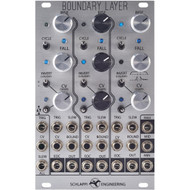
Boundary Layer consists of three identical channels that can perform a myriad of functions; LFO, VCO, EG, or voltage controlled slew, and a lot more. Each channel consists of a Rise, Fall, and CV control (with a CV input) to lord over the shape of the outgoing channel's voltage, and you can trigger each channel with a universal trigger input, each channel's individual trigger input, or by flipping the Cycle switch up. Each channel also has the aforementioned CV input (for modulating the Rise, Fall, or both via a toggle switch), a Slew input, and a Bound input, which can make interesting rhythmic events and simulates bouncing ball effects pretty easily, among other things. Unlike the CV input, there's no onboard attenuation for the Bound or Slew inputs.
There is a CV Invert toggle (inverts patched in CV, or when no CV is patched in, changes the envelope shape between exponential and logarithmic), and there are End of Cycle (with the default triggering happening on the End of Rise, though this can be switched for each channel to End of Fall via a jumper on the back of the module), and main outputs for each channel. The three channels are sandwiched between a global input section (Trigger In, CV In, and Slew) and a global comparator-based logic output section, which select the Max, Mid, and Min of all three channel's voltages. You can also switch the Min output to a Mix out with a jumper on the back of the module, which is how I set mine up.
There's nothing I like playing with more than envelopes and slew, and Boundary Layer does not disappoint. There is, of course, the possibility to run the module as three independent channels, and having three separate function generating channels is great. Using the same trigger for all channels, multing CV control for all, etc., has its uses, but I was really more interested in seeing how it would interact with itself and integrating the logic outputs in a patch, linking them all together and using it as one mongo module. But first, I wanted to see how well it would do in a more traditional function generator sense.
On an individual channel level, there is so much you can do with seemingly so little. So many waveshapes to make; so many ways to control things with merely the Rise, Fall, Invert, and CV/shape. Rapidly cycling a channel and using its output patched into a 1V/oct on a VCO, tweaking the Rise and Fall, adding CV to modulate either or both parameters, and then playing Boundary Layer to control a breathy droning VCO, is extremely satisfying. Function/envelope generator as an instrument is impressive. Using Boundary Layer as a sound source itself, and with a little reverb or delay thrown in, and you can get a lot of interesting sonics and movement. Everything from thick drones to more basic waveshaped high-pitched ambulance sirens, to complex twitchy swarms of bees was easily had. With the Bound input you can really frame the pitch range of the output and even simulate the sound of filter sweeps with a patched in LFO (which makes sense, because the slew itself is basically a dual control low pass filter), hold steady a pitch, scale an envelope with some offset, etc. You can use it as an AD or AR envelope generator, for adding portamento, and with a gate input patched into the Slew input, you can sustain the voltage, creating an ASR envelope.
By using any of the other available channels' EOC or main Outputs, you can do a lot of interesting self–patching, which, with three channels and the logic outs, can get complex quickly. And this complexity is where Boundary Layer flexes its muscle. It's easy to get lost patching into itself, and I found myself really straining to hear what seemed like minor sonic and percussive differences when it was all patched up—par for the course here, but again, playing Boundary Layer, tweaking the controls of this interactive multi-channel machine brought about endless exploration.
Usually you'd see two channels of function generation (think the classic Serge DUSG, etc.), and so here the third channel is a treat. More treats? The three logic outputs. They add a lot more than you'd expect. Using the Min output (though any of the three worked similarly), patched into the Timbre CV input of the Endorphin.es Godspeed VCO for a slightly mutating low drone, sounded menacing and excellent, even without the VCO doing anything else dynamically. Likewise patching a droning VCO into a VCA being controlled by any of those global logic outs. In a thick patch it was distinguishable from everything else, adding an erratic sounding sinister background to a mostly standard drum and bass patch. Adding the other logic outs throughout the patch gave more related options, and though it definitely didn't always sound related, it was fun to experiment with to see how and where it added some extra punch or depth.
Going back to using Boundary Layer as an oscillator via the Mix output, it actually tracked pretty well, and with a sequence patched into the CV input acting as a 1v/Oct, produced a kinda tunable multi-timbral sickly sounding chordal melody very reminiscent of when phone lines would get crossed up, back when that sort of thing used to happen all the time. Things got really interesting when more CV was patched into the individual channels, there was so much movement…I used Five12's QV-L for some synched and syncopated LFO action, and it was a lot of fun.
And fun, well there is much fun to be had here. Whether it's synching everything up, self patching to the outermost layers of the galaxy, or using it as a three-channel FG/EG + extras utility module, Boundary Layer is imminently rewarding and a great addition to the Schlappi line.
Price: $325