

CV Polymorpher - Northern Light Modular
by Ellison Wolf
It's hard to underestimate the blue and gold card slot at the upper left of the Buchla 208/C on the Music Easel and desktop Easel Command. The original idea of the expander slot, to give one access via the expander cards to the Easel's internal circuitry so that you can putz around building little circuits on those cards, or to try out different resistor values for various parameters, was a very forward thinking one when the Easel made its first appearance. It's hard to believe how functional it still is. You can do all sorts of expanding and experimenting via the card slot, and even blow up an IC or two (like I did) by mistakenly touching the voltage rail on an inserted card to something it should never touch. Since my mishap, I've gone on to leave the slot more or less alone with regards to the blank cards, leaving my experimenting to more musical pursuits. I have, however, since collected a few expander slot goodies like the Music Thing Modular Easel Clock In/Output, the excellent Portabellabz 208 Toolbox, and now the Northern Light Modular CV Polymorpher.
The CV Polymorpher brings Ornament & Crime functionality to the Buchla environment, and this is no small thing. How many times have I wished for more LFOs, more clocked CV divisions for modulation, more easily routed CV on my Easel? Well, a lot. There are module 4U versions of o_C, but since this one utilizes the card slot on the 208/C, you don't need an external boat.
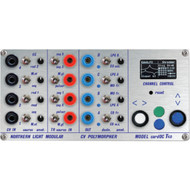
The CV Polymorpher is a four-channel, dual-applet control voltage processor with twenty-four switchable destination or source modulation targets. With a three-position toggle doing the selection for each (center position is off), it gives a lot of options for expanding on CV experimentation, something the 208/208C is already grand at. CV Polymorpher is a nicely built machine, taking cues from all Buchla instruments whose aesthetic has been mostly unchanged for fifty odd years. With the brushed aluminum faceplate, correctly shaded blue text, and various multi-colored banana jacks, it looks as you'd expect.
On my BEMI-era Easel it sits completely flat when it's all plugged in, and is slightly angled for 208C users due to the angled nature of the 208C, and I do wish it were angled for the Easel, as you have to be somewhat on top of it to see the screen. As for the screen, it's a small, high contrast OLED, and maneuvering about it is mostly intuitive; especially if you're at all familiar with o_C already. Buchla instruments can be pretty finicky, and I was pleased to see among CV Polymorpher's features that it includes buffered in and outputs. Having the buffered inputs lets you mix CV from the card bus and external CV into one voltage, and having the buffered outputs is great for pitch tracking stability when you're pushing CV all over your Easel.
While I'm accustomed to o_C, and have used it many times, I'm not what I would call "fluid" with it; it's still clunky in my hands, and with so many apps on board (CV Polymorpher came loaded with the Phazerville suite), it can be a lot to ingest. It's easy enough, though, to pick out a few favorites and stick with them to learn the ropes. I wanted to do that, but also desired to get more acquainted with some of the other less familiar-to-me apps on offer here. The apps are either full screen and four-channel, or split the screen into two, using the Hemisphere suite of applets. Since the applets on Hemispheres only take up two of the four channels available, you can select two applets to use at one time, like the Seq23 sequencer and the Vector EG.
Understanding the layout of CV Polymorpher isn't too tricky. The left side is for incoming CV to spread around, and you can select the internal source of the CV or patch in something and use the attenuators available for each channel to tweak it to taste. The middle section is for selecting the trigger source, and, again, you can select an internal source for the trigger or patch an external trigger in, and tweak the amount to taste. The right side is the CV Out section where you select the destination for the CV via internal routing or by patching out. The apps/applets are highly customizable, and it's interesting to note the dichotomy of the Easel's completely hands-on approach in contrast to that of an app-based module, such as CV Polymorpher is, to pair it with. It's a good combination.
I love the five-step sequencer on the Easel, but being able to run any number of steps up to thirty-two, via the Seq32 applet, and with thirty-two different customizable sequences on tap, with Gate and Pitch out, is pretty incredible. Granted, it is much less immediate to use than the Easel's sequencer—you have to scroll to select the value for each note, scroll for sequence length, etc.—but it brings a lot to the table nonetheless.
Ditto for adding LFOs or extra envelopes to the Easel. You can get pretty tuned in and CV some of the waveshape parameters for this, and mapping or patching throughout the Easel not only expands on modulation opportunities, but also allows for fine tuning your LFOs and envelope shapes, and the triggering of these. On an Easel, this is like finding a hidden universe.
There are apps for creating sequences, LFOs, envelopes, melody generators, bitcrushing, and on and on. Being able to select trigger sources, roll in onboard CV and adjust the amount to mix…well, that's a lot of functionality and flexibility in a small package, and it's easy to save and load all of this as well.
One of the main reasons I (and so many others) love the Easel is its hands-on approach, and pairing the CV Polymorpher with the Easel, expanding on the possibilities within, while utilizing the former's one-slider/toggle/knob-per-function approach, really opens up and adds immensely to the available sound palette. Get through the menu diving and scrolling of o_C, and you've got an extremely powerful addition to your Easel. Add to all of this with the Portabellabz 208 Hub (on my list!), which lets you use up to three expander card modules at once, and the Easel can grow to new heights.