

Discrete Map + A/B/C Expander - New Systems Instruments
by Ian Rapp
Even if you're a well traveled student of philosophy, who's already submerged oneself in all manner of studies concerning philosophical ideals, and therefore has a sturdy background (at least, in theory) of the history and ideas of the philosophical greats, the rabbit holes—those massive dens—that you can get lost in, in all manners of anything with a philosophical ideal, can be immense and time consuming. Most are familiar with more well known, "mainstream" philosophers like Socrates and Marx, and not so with less mainstream ones like Parmenides or Diogenes the Cynic, whose name I am envious of.
At a glance, it's easy to not see the connection between synthesizers and philosophy. Patch, press, turn, etc., and make some noise. What does that have to do with anything but electrical engineering, math, and sound/music? One aspect of this mixture between philosophy and synthesis (as opposed to synthesizers) that I find interesting, is that even with a deep backstory, plenty of meaning, tons of thought, and a lot of circuitous thinking, you still might only get something that sounds like a fart. Sound creation and synthesis both have their roots in deep thought, and there—at least a good portion of it—shall remain.
New Systems Instrument's Discrete Map has a gargantuan (for a module, at least) 800 components and is firmly inspired by a few things, the most easily visible being Buchla's slider-based MARF. Less obvious as an influence are the theories of German philosopher Georg Wilhelm Friedrich Hegel. I absolutely will not be lecturing on Hegelian theory here, that is a trip for you to take solo, but suffice it to say, that after doing a web search for "What does Hegelian theory mean," and then a subsequent search for "Hegelian theory in simple language for Dummies," I can see how Discrete Maps offers up some of his theory in its operation. At least, as far as I can tell.
While most sequencers operate with a square/pulse wave, Discrete Map is triggered by an internal ramp wave or the voltage contours of an external input and operates much differently because of it. LFO, envelope, random S&H waves, noise…in terms of sequencing this is an experimenters dream. Discrete Map is your groomsmen in, yes, the requisite tux, but it's a white one. Or maybe blue. Or pink. You can still synch Discrete Map up to a traditional clock to work that way, but that's not what we're here for, and would Hegel approve of using it a normal way? I have no clue.
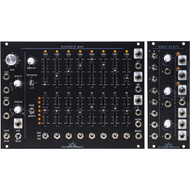
For every action there is a reaction (Newton's Third Law of Motion), and in terms of adjusting the sliders on Discrete Map, a simple action/reaction can institute immense change, and these reactions can set off interesting chains of events and this is a lot of DM's charm, and making most of these changes are two rows of eight sliders each. But first, the outline: Discrete Map can be broken down into three sections in terms of function; a Clock section, a Map section, and an Event section. In terms of layout it's broken down into a left side, and then a top and bottom part…mostly. Furthest left, the Clock section is its own self-contained area, and this is what controls the internal ramp signal that sets everything in motion. This section consists of a Rate control, V/O input, Rate CV input (with attenuation), Sync input, Sync/N input with a Count control (to set how many pulses it takes for the DM's ramp to reset), an End of Cycle output, and switches for Loop/Once operation and Fast/Slow (for the ramp speed; it can go from four minutes to 12kHz).
The Map section consists of the eight sliders at the top of the module for controlling outgoing voltages for each stage, and there are LED indicators for the active stage above each slider. There is a Gate Length knob and associated output, which determines the length of the outputted gate, an f(X) Range switch (+ -, +, +/2) that determines the range of the top sliders of 10, 5, and 2.5 octaves, respectively, and this section also includes the main voltage output, f(X) and also a +Y input, which is a precision voltage adder that's useful for transposing the X output.
The Event portion of Discrete Maps is where the eight sliders lie, that either control the position of which a stage plays in a cycle, or the length the stage is played for, via a Posit(ion)/Length toggle. Each of the eight stages also has a Rise/Off/Fall switch to select when that stage will trigger. When using, say, a triangle wave for the X input instead of the onboard ramp wave, you can select which stages get triggered as the triangle rises, and which ones get triggered on the triangle's downward journey—extremely cool. If you can't see just how fun, powerful, and potentially interesting this concept is, then it's good you're here; more or less, Discrete Map is here to help you break out of your sequencing comfort zone. Note that when using an external signal (notice I did NOT say "clock"!) patched into the X input for triggering, the whole Clock section is completely bypassed. The Event section also has an EXTernal input that cancels out stages when the patched in voltage goes high, for yet another way to mangle the timing, a Ramp output (normalized to the X output) for more syncing possibilities, and Above and Below inputs that define the extreme ends of the voltage range of the sliders.
Before we move on too far already with the main show, there's also the A/B/C Expander which lets you route via toggles, each of the eight stages to one of the three (A, B, or C) groups for more syncing. There is a Threshold input (with attenuator) for each channel to add to the threshold for each group. The expander also has a sequential switch section in coordination with the three groups A, B, and C, where you patch in audio into any of the groups and when that group triggers its gate, the audio passes for the corresponding group through the COM output. This can also be used in the reverse, where the COM is the input and the A, B, and C jacks are the outputs. You can use the bottom sliders to control the output length for each group, and can create some pretty interesting textures.
While some expanders can seem a bit superfluous, the A/B/C Expander really extends the possibilities of what you can do, which is why I bring it up here and not tack it on to the end of this review. With the Discrete Map/A/B/C Expander tandem, whether it's a melody, drum, bass, or drone track, adding the expander really adds to the possibilities for additional syncing, melody enhancing, envelope shaping, or whatever you can think of. As an example, using a spoken word sample/loop I recorded off a police scanner for the input of switch A, a premature halloween scream for B, and a hi-hat that sounded more like a triangle for C, it created a unique tapestry, a layer that I mixed underneath an acid-y track I was working on. It didn't make that much sense musically, but that was more operator error than anything, and it showed me a bit what I was in for.
One of the things that makes Discrete Map interesting is the lack of easy quantization, both for the outgoing voltage of the top sliders, and even more so the bottom sliders for controlling the length. This isn't a precise vehicle for sequencing, but I came to understand how much less I would like it if it were. I realized that if it were all perfect and tightly knit, the human factor would be so much less, to the point where I think it would detract from the overall usage and enjoyment. Besides, it's easy enough to run the X output into a quantizer if you want more predictable and controlled melodic happenings. Still, my favorite thing to do with Discrete Map is to tweak the Length and Position while it was running, and I lost many hours doing just this. Using the Length control as a way to manipulate time and create groovy (or un-groovy) rhythms and melodies, well, when I was using it for drum purposes it sounded eerily reminiscent of my beats when I started learning how to play the drums way back when. It's no wonder my parents tried to steer me towards a wind instrument when I was a kid.
Even at its most basic, adjusting the sliders in Length mode intrinsically feels good; right, and CV'ing this—and furthermore, switching around the Rise/Off/Fall for each stage—can bring about really wonky timing and immediate re-placement of stages in a sequence. I love the ability to do this in real time and not either program it or just submit to merely randomizing a sequence with the push of a button. For so long, for me sequencers have long been "program/set-and-forget", and it's really amazing how just a few small tweaks of the bottom sliders, in either mode, can alter so much so quickly. No setting or forgetting. You can really customize the feel of the X output; swinging it a bit, adding some stutters, skipping steps, lurching the stages by moving the lower sliders about…And again, it feels good to have your hands involved in this. You'll want to do this. For performance, a knob or pad based sequencer just can't hold an LED candle to a slider-based sequencer. I find Discrete Map to be very easy to play on the fly, tweaking the sliders for variations on the time and order of the stages, self patching to mess with re-triggering or consistently changing the cycle length, and toggling through each stages' trigger point and switching up the group assignments on the expander. It can easily be the heart of a dense patch.
But lest you think that Discrete Map is merely a non-linear sequencer, it is not. You can use it in Loop and Slow mode to craft custom LFO's, flip the speed toggle to Fast and use it as a custom-shaped graphic VCO, or use it in one-shot mode to trigger random or synched custom shaped events in a larger patch, in order to accent a phrase, emphasize a beat, or add some zest. You can get really creative in the patching of this, like when using either a 1v/Oct output on a keyboard (or any pitch CV output) patched into the V/O input, where the event will be tied to the pitch of the patched instrument. In this way it will go through a higher pitched stage faster due to the higher (faster) frequency than a lower, slower one.
As a graphic LFO you can use Discrete Map to make a stepped waveform, shape it however you want, and then if you tweak the bottom sliders in Location mode from time to time you can get a randomized sample and hold-y type thing. Switch to Fast mode and you have a very configurable stepped pulsewave oscillator, which you can then sync and patch into the Rate input with another VCO for some FM, to create some gritty, harsh tones and track it through the V/O input. The PWM tones you can get from Discrete Map can be huge, and being able to do this in such a bespoke way, where you can physically make the waveshape, is a feather in the cap.
One thing, I do wish there were a way to have the bottom sliders affect both the position and length of the stages simultaneously, as when it's switched to Location, all of the stages operate at the same length, and when switched to Length you can't change the order of the stages. To have the ability to do both so that position and length were tied together would be really interesting, even if it winds up only leading to chaos.
Discrete Map is a load of fun and really interesting, both in concept and in the real world. There are so many things you can do with it, there's no shortage of possibilities for experimenting. I've been really into non-linear sequencing for a while, and given the hands-on nature of Discrete Map and A/B/C Expander, it's hitting my sweet spot in a big way.
Price: Discrete Map $479
A/B/C Expander $199