

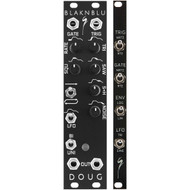
Doug & DougSwitches - Blaknblu
by Ian Rapp
Blaknblu's versatile modulation source, Doug, is nothing fancy, but the simplicity of the faceplate belies its versatility. It can be used as an extremely shapeable LFO with an endless array of waveform shapes, or a six-phase envelope generator that can be looped or triggered.
Doug has a Gate and Trigger input at its top end, two identical outputs at the bottom, and quite a bit going on in the middle. It has a Loop/Single shot switch, an Envelope/LFO toggle, and a bi/unipolar toggle as well as six potentiometers that share double duty, depending on if you're in LFO or Envelope mode. This is where Doug gets interesting. If you're in LFO mode, those six controls act as amounts for five different waveshapes: Triangle; Square; Saw, which is a dual function control with full CCW as a falling sawtooth, and fully CW as a rising sawtooth; S&H; and Noise. The sixth knob controls the overall Rate of the LFO. Doug can act as a traditional looping LFO (with the Loop switch on), or a one-shot LFO with a trigger patched in. When a trigger is patched in LFO and Loop mode, the Trigger input acts as a hard sync, restarting Doug's waveform to its cyclical beginning…going back to Doug's roots, so to speak.
A 2 Hp expander module, DougSwitches, makes some of the jumper-available options on the backside of Doug available to use; the Trigger to return to zero or not, the Gate input to return to zero or not, Envelope shape (log or lin), and triangle or sine for the LFO.
What makes Doug special, is that it can put out a nice, friendly, traditionally- shaped waveform, like a sine or square, or combine things to get something much more askew. Doug likes askewness. The waveforms are mixed (as opposed to summed) so that the output is never pushed into distortion, keeping Doug friendly.
To use Doug as a traditional WAHSDR (Wait, Attack, Hold, Sustain, Decay, and Release) envelope, set the switch to Envelope, Single Shot, and Unipolar. When in Envelope mode the six controls each act as a single stage of a six-stage envelope. While there is no CV control over the stages, the ability to sculpt envelopes and delay the attack stage creates a lot of interesting potential. You can use the envelope to control the mix amount for a kick or snare so that the reverb opens up after the attack of the percussive hit, doing the same with melodies, being creative with filtering, delayed opening of a VCA, and so on. There's a lot you can do.
There's nothing tricky or hidden with Doug; what you see is what you get, and it's a great take on a run-of-the-mill LFO or ADSR. I love the ability to make interesting and unique LFOs—as well as standard shapes—and for the ability to do one-shot triggering of them for use throughout a patch.
Really though, I find myself using Doug primarily in Envelope mode. I'm not sure I've come across a "wait" stage by that name, usually it's termed "delay," but either way, I'm a fan. I love being able to create highly detailed envelopes, and delaying envelopes is one of my favorite tricks of the trade for adding a little extra something something to a patch. Sometimes when everything is tied to a grid, there's just not a lot of space in some timed/triggered instances, and delaying something like an effect or filtering can give a little opening for things to cut through a mix better and stand out. There's a lot to love about Doug; it's a great little module that checks a lot of boxes.
Price: Doug $119, DougSwitches $49