

Filternator - Kanawha Music and Art
by Evan Morrow
Perhaps the only Eurorack manufacturer hailing from beautiful West Virginia, Kanawha Music and Art's Chris Nagorka has been working on pipe organs in his region for over forty years. How that experience translates into modular, who knows, but he definitely has a unique take on the modular format. With modules like their polyphonic Long Division II, which revolves around recreating aspects of the pipe organ in Eurorack, and their 48 Gates, which consists of—you probably guessed it—forty eight gates (that's a lotta gates), Nagorka's take on the format is singular, and with their unique take on things, it feels a bit like they grew up on a desert island hearing about synths and modular as opposed to being saturated with the stuff, and their perspective is something I appreciate.
The module sent for review, The Filternator, is a switchable, completely passive filter with a small parts count that uses induction coils instead of resistors for the filtering. This isn't the first time this has been done (Hammond, for instance, used this on some of their instruments), but it's pretty rare in modular, and in this instance, Filternator, employs induction coils over resistors so that there is no amplitude loss in the signal. Instead, the inductors boost the signal near the resonant peak, creating a distinct sound. While I've used, soldered, and can spot the difference between a through-hole resistor and an axial inductor (they do look similar to one another), on a circuit board, I realized I didn't know the difference in functionality between the two. A little searching reveals that a resistor resists current flowing (I knew that!), whereas an inductor stores electrical energy in a magnetic field (I did not know that). Always learning…
I'm a fan of passive modules and love to see how, and to what creative lengths, it's possible to empower the powerless, so I was interested to try out a fixed passive filter made with inductors.
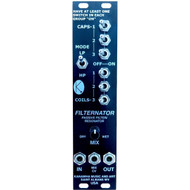
Ignoring typical Eurorack convention, Filternator has directions on top of the faceplate ("Have at least one switch in each group "on""), and with its low component count and no way whatsoever of ever getting a shock, seems like it would make a great DIY project and learning tool for beginners. It only comes in an assembled format, and there's no hint of a DIY version being released as of now, but maybe this will change in the future.
Filternator operates by choosing either Low Pass or High Pass mode, then selecting from one of three capacitors in the signal path, and one of three induction coils in the signal path to set the frequency and resonance, for a total of eighteen (unless my math is incorrect) different filtering combinations.
A mix knob lets you adjust the amount of the filtered tone to the output, and using the DIY-favorite opto-coupler to introduce CV control, you can automate this mix amount with some external modulation as well.
In practice, Filternator is more like a selectable single-channel filter bank than a traditional VCF, and even though you can get similar results from almost any filter, the ability to select only three cap values and three inductors, makes repeatability easier, if that's a desire. Obviously, filter sweeping is off the cards, but it's interesting switching the values for both the caps and inductors around to hear the differences between the selections, hearing the different combinations. This worked especially well when auditioning snare, mixed drums/percussion and bass sounds and reminded me of going to the ophthalmologist for an eye exam, where they are endlessly asking whether you like "A or B." Using Filternator is more pleasurable, though having good eyesight has its own perks as well, so there's that.
Filternator is a cool module. I do wish that the values of the caps and inductors were user replaceable; it just seems ripe for that type of experimentation, though while there are only three values available for the caps and inductors, it gives a surprising amount of flexibility and length in terms of sound than you'd at first think. I was pleased with the versatility that Filternator holds, and according to the manual it spans about 296Hz to 3.4KHz. I still think maybe Filternator's most potent usage might be as an educational tool to teach the theory and the inner workings of filtering, but it also works great for fixed value filtering.
Price: $100