

Monumatic - Knobula
by Ian Rapp
I've always been a primarily one-knob-per-function guy when it comes to my mostly-performance-based modular setup, as I find the quickness and ease in a OKPF workflowful is great in terms of creation as well as performance; to me, it's just more fun, and I don't want to be stalled by needing to figure out (or re-figure out) how to get something to function a particular way. Recently, though, I've had to rethink this limitation, mainly due to the fact that I've realized (slowly, albeit) how many manufacturers and designers are employing a very effective one-knob-per-two-functions ideology. I've seen this implemented in different ways on modules from various manufacturers, like when the left side of a control is for one parameter, and the right side another (think LPF/HPF), or by using a Shift button to access valuable secondary functions with a single control.
London-based Knobula uses both techniques, and the ease of which their modules open up complex operations, sounds, and features, all while being very playable—along with a smooth, enjoyable workflow—is a hallmark of the company, and they do an impeccable job of making sure everything is easy to access and easy to navigate, with no guesswork or memorization needed, no meaningless text, and no confusing symbols.
They came out on fire a few years ago with their poly synth module Poly Cinematic, and have struck gold again with the successor to that module, Monumatic. While Monumatic has the same 56 oscillator 8-voice capability and is the same size (12 Hp) as PC, this time around there is just more of everything; more waveform options, more modulation options, more filter options, and more effects options. In this case, more is definitely better.
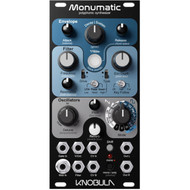
Looking at how much more, and starting at the top, Monumatic can be broken down into four sections (including ins and outs). The first section is a very flexible ADSR Envelope, with secondary Volume, Glide, and Chord select functions. A Trigger button (for manually triggering chords) allows the saving and switching/auditioning of chords, as well.
Next, the filter section has controls for Frequency, Resonance and Envelope Depth, with secondary controls for Voice Pan, Pitch Envelope, and MIDI channel selection, and there are six filters to choose from: a 4-pole Butterworth low-pass filter (a not-so-common (in Eurorack) filter design that is supposed to produce the best output response with no ripple in the pass band), a 2-pole low-pass filter, a four-stage all-pass filter for phase shifting, a 2-pole dual-peak notch filter, a vowel filter (Ahh, Ay, Eeee, Eye, Ohh, U sounds), and a 2-pole high pass filter. For a little added flavor the filters can be driven post-filtering by a two-position Drive switch, and there is also a three-position (Off, Half, Full) Key Follow feature as well, for determining the filter cutoff point in relation to the note being played.
Monumatic's Oscillator section is the heart of the module and covers a ton of ground, offering up sixteen virtual analog modes: Casio CZ-style phase distortion, Arp Solina string synth, "noisy cassette" strings, two Roland super-saw modes, Polymoog vox humana, PWM, pulse, square, square percussion, Oberheim X8 inspired string, three percussive drawbar organ modes, asymmetric sync saw, and sync square. Additional to the Mode select, there are Detuning and Pitch controls with Temperament and Fine Tune secondary features.
As for interfacing, there's a TRS MIDI In (with MPE/Poly aftertouch), bipolar V/Oct and Filter inputs, a Gate input, and two easily assignable CV inputs, where you can modulate practically any/everything. There are individual L and R outs, for mono or stereo functionality, and even a nice sounding reverb and stereo chorus on board. You can switch between mono or polyphonic modes, which means that on top of playing chords, you can also arpeggiate them.
Knobula modules always sound superb, and going through the oscillators, the span of sounds available here is vast and excellent. It was easy to dial in huge reverberating church organs, fat PWM sounds, and rib-splitting supersaws. I found the X8 voice to be specifically grand, especially paired with the LP24 filter mode, while modulating the cutoff with the resonance at high. Always a fan of synth vocal/formant sounds, switching to the Vox mode paired with the Vowel setting for the filter, you can get everything from those unsettling, yet addictive android vocal tones to Wizard of Oz Munchkin chanting to monster grunts. I even got some grandma "Oy yoy yoy's" in there as well. Not sure how valuable having that in your track will be, but it did make me reminisce about my G'Ma's chicken noodle soup. It cured all. Anyway, turning the Release all the way up so it sustains the sound, and with a sequence patched into the V/Oct input I got some nice blurred shifting melodies and mutating drones, which became especially odd with a handful of reverb added on. The sounds are impressive, and the way they're constructed, virtually, without using samples, means that each sounds timbre can be adjusted using the Detune control, no small feat.
Adding to the functionality and sonic possibilities found in Monumatic, it also uses a rarely found self-adjusting tuning system called hermode tuning for incoming MIDI notes. It's a method employed with multi-personnel musical ensembles to aid in creating a more harmonically rich sound, as opposed to other tuning methods, which are more concerned with accurate pitch tuning on an individual level. Whether or not this means anything to you, on Monumatic it's something interesting that you can play with. Want your chords to sound harmoniously rich? Thin, off-kilter and sickly? You can do that here.
While I loved using Monumatic for creating arpeggios—the sounds on offer are definitely worth exploring in this manner, it's really in the playing of chords where it shines. It's incredibly versatile, tweakable, and is more than a mere update to Poly Cinematic (itself still a great module). Rather, it's a reimagining of what a compact, full-featured polysynth Eurorack module can be. Whether you use it for mono or polyphonic purpose, you'll find a lot to explore here, and a lot of ways with which to do so.
Price: $449