

Oradea + Arad Expander - XAOC Devices
by Jason Czyeryk
Filter sweeps, ring mods, FM'ing…there are certain sounds in the synth world that are the cornerstones, the reasons why electronic music and sound is so intriguing and addictive. Pinging a resonant filter is another, and without a doubt one of my favorite things to do in modular. There's something deeply satisfying about those sounds that I can never get enough of. Enter Xaoc Devices’ Oradea.
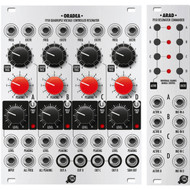
A quadruple analog resonator with individual controls for each channel, Oradea contains four bandpass filter channels (A, B, C, D) that are situated in parallel and span a frequency range of 16Hz to 20kHz. Each has a Center Frequency control, a Peaking control to tune the filter, and a Level (VCA) control. Each channel also has a CV input to control the frequency (this is your 1V/oct input), an Excite input for pinging, CV inputs for modulating the Peak and VCA (this has an exponential curve to it), and a Phase switch, which inverts the phase of the waveform. This is helpful to avoid (or maintain) frequency cancellations due to phase issues, something that can be a problem when the four channels' frequencies are close together at the Sum Output. But we're getting a bit ahead of ourselves here…
As for outputs, along with the Sum Out, there are individual outputs for each channel, which allows for more detailed routing and processing so that you can use Oradea as a four-frequency resonant filter bank, or as four individual channels of resonant filters. There are three "global" type inputs that rule over all four channels; a main Input, (so that all four channels can use the same source signal, but still operate individually), an All Peaks CV in, and an All Freq in.
Additionally, there is the 6hp Arad expander, which adds four additional functions; clickless channel muting, buttons for manual triggering of each channel, individual channel inputs that are added to Oradea's Sum output, and individual gate/trigger inputs. If you're going all in for Oradea, Arad is essential.
I really love processing audio through filter banks, and resonant filter banks as well. Running a three-channel drum track from Modbap's Trinity patched to the main Input, with the Type for each drum sound in Round Robin mode, and it takes a minute to get it set right. The Round Robin mode, with the changing drum type for each, and therefore constantly changing frequencies for each, makes me realize I need to do it step by step, to slow things down a bit. I isolate the kick drum first, and tune the filters channel by channel, from lowest to highest. Since Arad has channel mute buttons, it's easy to compare which filter channel/s come close to what I'm looking for (which is what, exactly?) once I've tuned them all. For saving sound samples, something I like to do with drum sounds I've created, this is invaluable. I'm fully aware that once I bring in the other drum elements from Trinity it will change everything, and unsurprisingly, it does. It's interesting—but, again, not surprising—to note that while a couple of muted channels sound best when it's only the kick drum, once the snare is introduced, the overall sound is more funky. I let all four channels go live and introduce the last drum element from Trinity (a hi-hatty sort of thing) and after some tweaking finally get something that works great. It sounds akin to a toy drum kit being played in an empty basement while being smothered by an old sleeping bag, which in turn reminds me of a Mike Portnoy video where he rocks the hell out of a Hello Kitty drumset. This is when I decide to play with fire and introduce a little CV into the mix. I'm hesitant to change the frequency bands at this point, so I opt for some synched triangle wave LFOs from Xaoc's Batumi in Phase mode, patched into each of Oradea's Peaking inputs. With a little reverb thrown in, this makes for a wild ride. Multing those triangles in order to double up on each channel's respective CV in for the Level, and it becomes a syncopated rhythmic audio mishap, albeit with some interesting harmonics. Maybe I need to reel the Peaking levels a bit. With the individual outs for each channel it can be interesting to route them to different effects or for further filtering, and obliterate the input signal even more. What's also fun, instead of using the Mix output of Trinity, is to use each individual output and use Oradea as three separate resonant filters. In this way, you can hone in on the sounds for each drum element, and then with Oradea's All Freq input you can sweep all four filters at once.
Running the same tests with a chord as the input signal, you can use the same 1v/Oct signal for both the chord generator—in this case Knobula's Chord Pilot—and the All Freq in on Oradea, and you can fine tune it all and get some very interesting harmonic changes that coincide with the melodic changes. There are all sorts of ways to muss it up further; CV the VCA, sync the pinging of the filters, and so on. Speaking of pinging, I've saved my favorite use case for last.
Oradea excels as a sound source, and patching a trigger into any channel's Excite input for pinging, while slowly bringing up the resonance (it gets resonant fast), and after tuning each filter and patching into a panning mixer (with some reverb on each channel), and I'm in happy place. Oradea sounds so organic, that with just reverb and some slight modulation on the Frequency and/or Peaking, the movement—along with the panning—combined with the pings is divine. This is what modular is all about. Or, at least a huge part of it. In another instance, pinging all four filters clocked at a moderate pace in a sequence (via Batumi) can bring on an acoustic instrument sounding vintage doorbell effect. Speed that up and it simulates the strumming of a stringed instrument. Since you can tune each filter to a desired note, you can summon up specific chords and then use the All Freq input to transpose the chord. It may take a minute to tune the filters to precision, and it helps to tune them individually and to turn up the Peaking—which controls the length of your decay—to the max for more sustain of each note. Sometimes I would use three channels for a strum pattern and the other pattern layered on top of something, where I would combine the ping with a kick or snare and mix it to taste. Add a slight delay on the ping trigger from the kick or snare hit, and there was a sort of hollowed out flam that sounded pretty amazing. Add some reverb on the ping, and it only heightened the perceived space and depth of the overall hit.
Mixing in audio, like, say, a sequenced complex waveform, into any one of the channels that's tuned and pinging can be interesting, and if Oradea and Arad are patched up, that means that with the four audio inputs and the four filters (if resonating), you have up to eight sonic elements coming out of the Sum Out.
Resonating filters can be all over the place in terms of gain, self-oscillation, and resonance peaks, and Xaoc has implemented their own unique circuitry to deal with this, to make them more consistent and less prone to bouts of ear-splitting howls. This is just one of the many (many, many) ways that make Oradea and Arad such a joy to ping and play.
These two modules, along with some hefty LFOs and envelopes, are a must in a modular toolkit. Those crickety chirps, crafted sine heavy kicks where the decay can be tuned with the Peaking, and glassine pinged sequences, are as much fun to create as they are to hear. Oradea and Adar might just be my favorite setup for pinging filters. Now if only there was an 8, 16, or 24 channel version for even more complex patching.
Price: Oradea, $599, Arad Expander $149