

Organelle S2 - Critter & Guitari
by Alex Vittum
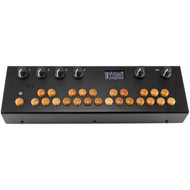
For the uninitiated, the Critter & Guitari Organelle is an electronic musical instrument with an embedded computer running Pure Data (PD) as its sound engine. With the first iteration of the Organelle launching over a decade ago, the newest version, the S2, trades light blue for black, but otherwise keeps the same iconic look as its predecessor, with it's sturdy build and its simple, elegantly utilitarian industrial design that's equipped with the same signature twenty-five round maple keys, four mappable control knobs and an OLED screen. Its size and weight (just over a pound, 2.1” tall) feel nice, too, and it sports audio ins and outs, micro SD, HDMI and USB, so it's easy to integrate in any situation.
While it no longer has an internal speaker and might look the same as previous Organelles, the internals found inside the S2 tell a different story. Built on a 1.8 GHz quad core processor, the S2 has approximately double the power of the original and the difference in performance is dramatic, so those of you who struggled with resource heavy patches in the past, take note.
The most unique aspect of the Organelle, the wooden peg-like keys, are really fun to play and I found them to be springy and tactile, though with slight mechanical noise (and not to mention they do lack velocity sensitivity). Realistically, playing a ripping solo is challenging due to having only two octaves of the small size keys, but you can add a MIDI controller via MIDI TRS or USB, which is simple enough to do, and will open up many new possibilities.
While the upgrade in processing is an enticing prospect, still, the most exciting part of the Organelle ecosystem is how it joins instrument building and music creation. If a beloved filter, a specific type of delay, or a customized range for a knob is desired, you can program it, make sounds, and continue to iterate.
As for its most important feature, it's sound, I am impressed: it’s a great sounding instrument. I pulled up a patch called CZZ-Multi in the synth section and it was warm, with some digital woolyness; punchy, and inviting. I played odd clusters of notes which sounded awesome, and then enabled the sequencing alt key which recorded my performance in real-time like a looper would (including overdubbing). The keys plucked the four voices percussively and overall it had a nice energetic sound.
The amp, pulse width, and tone envelopes each have their own page with four control knobs assigned to each stage of the ADSR envelope, great for full control of the envelope stages, though this happens only one at a time. The Master page, however, enables percentage control of each parameter, which means a one-knob-per-function workflow, which is immediate and musical. It's a great example of how to use only four knobs for dozens of parameters within a given patch.
The wooden keys also play a functional role in navigating various settings like recording, playback, and overdubbing. The harmonically rich patch Additive Synth, for instance, contains a unique sequencer menu by holding the dedicated aux key in combination of the first and second set of accidentals (C#, D#, F#, G#, A#). Also, holding aux with a natural key (C, D, E, etc.) will choose a sequencer slot where fourteen sequences can be stored. There is, however, no labeling on the top panel indicating any of the aux controls, so there’s muscle memory needed to navigate this instrument, though the OLED will always clearly indicate which controls are being activated. At times I found this a bit inconvenient and sometimes even frustrating, but there's always a tradeoff for flexibility, and I think this small quirk is a worthy time investment considering how powerful the Organelle S2 can be.
As a synth, the Organelle is really powerful, but it's got more up its sleeve than it, as it's also a sampler. With its onboard electret microphone and compelling sampling preset patches, I grabbed a bell and a percussion mallet and had a looping sample in moments. This is by far my favorite workflow on the Organelle, and resulted in hours of experimenting, pitch tweaking, and pattern sequencing. At first I found it challenging to coordinate sample recording—pressing the aux key while also holding the instrument I wanted to sample wasn't exactly easy—so I connected a keyboard foot switch to the pedal input for seamless record enabling and found the perfect fix. Since the onboard mic does pick up noises made while operating other keys, the footswitch helped not only with handsfree operation, but with also keeping that shuffling sound from making it into the recording. I highly recommend an external footswitch for this. There is a low profile toggle switch that designates the input type from the onboard mic to a ¼ stereo input (yes!) for use with a guitar, synth, drum machine etc., which is a nice addition, and while I found the 16-bit/44.1k sound quality to be great, recorded sounds captured via the onboard mic tends to be a more lo-fi type of sound. I think it sounds great; it's not quite as lo-fi as an Casio SK-1, but it nods in that direction, and I really enjoyed using it.
Diving into effects, I started with a patch named Canabits, which switches effects based on clock division settings, and provides phasers, distortion, freeze, and reverbs, all shifting in time with the beat. Another patch, EFX 13 features effects stored per key that can be played in time or randomly, which was thoroughly mesmerizing. I also stumbled on CA Filter (Elementary Cellular Automata), which processes incoming audio with a spectral filter that sequences the frequency band levels and creates the most hypnotic visual feedback via the OLED screen. Overall, the effects are excellent and there are so many possibilities considering the sources choices, you'll want for nothing.
While it might be helpful to have some background in PD or coding, the Organelle doesn’t require any knowledge of Pure Data or any programming knowledge whatsoever. It comes loaded with a concisely curated collection of unique patches and Critter & Guitari’s website is very simple to use with numerous pages dedicated to demonstrating many of the patches featuring custom videos and plenty of information, not to mention that there's an entire community forum dedicated to sharing patches and ideas. I found this enormously helpful in orienting myself with Organelle's workflow and would encourage even experienced users to utilize these invaluable resources.
Though I didn't edit my own Pure Data patches for this review, I did successfully access the programming environment by connecting a monitor, keyboard, and mouse to Organelle’s HDMI and USB ports. Very quickly I had a patch pulled up on my monitor. It turns out recalling a patch on the Organelle will refresh the patch shown on the monitor so you can edit in real-time by making changes, testing results, and saving patches. Brilliant!
The Organelle S2 is as complex or simple as one wishes, with the ability to customize each patch, and with a fun workflow creates endless unique sound worlds, all potentially built, in part by…you. And the added muscle of the more powerful processor doesn't hurt, either!
Price: $499