

Play+ - Polyend
by Ellison Wolf
When it comes to choosing the right groovebox, many times it feels like a hierarchal compromise, where the compromises themselves always have you giving side eye when something new comes out. There's always that hope, the quest of finding the perfect groovebox, the one that ticks off every single box. But oh, how many boxes there are. Maybe your dream groovebox will never leave the studio, so any type of performative feature isn't that important. Maybe it's mainly going to be used for performing, so it just needs to be extremely playable, sturdy, and reliable. Maybe it just needs to be a scratch pad for new ideas. It can be a lot to ask of any one device. And think, how many one-trick pony pedals, synths, or amps do we absolutely covet, without holding them accountable for even a smidgeon of the amount of things we do (or hope to do) with our grooveboxes (and workstations, for that matter)?
Polyend introduced their groovebox, Play, in 2022, and right away it was understood to be one built for performance, something with a fast and efficient workflow, for easily generating ideas. Just about two years after it's release, Polyend came out with an updated version, Play+, and while on the outside it seems nearly identical (sans for the "+" on the case) to the previous version, the interior has been overhauled and includes some very welcomed additions; stereo sampling, internal synth engines, and audio over USB, to name the most impactful.
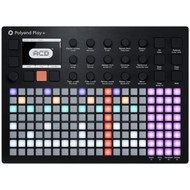
Play+ is a solid, and well-sized (11" x 8.25") machine whose playfield sports an 8x20 grid of low-profile light up RGB pads, fifteen rotary controls, and an LCD high-res color display that's surrounded by five beefy buttons and a main encoder. It will instantly look familiar to anyone who's ever used a grid (or adjacent) type of instrument/sequencer/controller like a Push, an 808, Polyend's Tracker (or the original Play, naturally), etc. In the way of connectivity, there is a microSD card slot for samples and files, 3.5mm TRS MIDI in/output jacks, a main stereo/headphone output, and a USB-C port for power, firmware updates, and (new to Play+) USB over audio output. It comes with a microSD card loaded with excellent sounding samples and synths, has some nice sounding reverb and delays onboard, and on the surface operates like a full featured step sequencer.
One of the best things about Play+ is that each step can have its own sample or synth, along with unique parameter settings. Each of the eight tracks can be any length up to 64 steps, each has a Solo, Mute, and Select function, and you can create Variations for each track—perfect for expanding on a track's theme. The adjustable parameters themselves that are available depend on what track, step, sample, or synth you are editing, but include things like Filter Cutoff, Bit Depth, Reverb, Delay, Track Length, Sample Start/End, track Move (and Micromove), Volume, Overdrive, and much more. With the samples and synths that come pre-loaded, and with how many ways there are to customize them, it's hard to imagine a sound or sample that you can't tweak to your needs. The samples run the gamut from typical 80s drum machines to cats meowing in space (or at least that's what it sounded like), and if space cats meowing on key in C minor aren't your thing, you can always upload your own samples. When it comes to samples, however, you can't do much sample editing in the Play+ environment. You can alter the start and end points, run them through a filter, add reverb, etc., but there's no time stretching or recording directly into Play+. In this respect, Play+ is more of a sample playing sequencer than a sample mangling playground.
Once you get the feel and operation for how to select a sample, synth, or parameter, how to cut/copy things, to dial in parameters, and get used to the double knob hit for switching parameter select, Play+ opens up and the fun truly begins. And it is fun. Play+ makes fast and easy work getting into the flow and coming up with great sounding tracks that can be shifted, manipulated, effected, warped, modulated, filtered, and on and on, in real-time, in almost any way imaginable. The way it, ahem, "plays", is Play+'s biggest strength, and the feel of the instrument is superb. I will say that the double tap function of the encoders can be pretty jumpy, meaning that it's easy to accidentally touch (or nudge) an adjacent encoder to the one you want, where it will trigger a different parameter on the LCD screen. You can turn this off in the settings menu, but that means that you'll only be able to use the main selection buttons or to do this, so it's a bit of a trade off. I wound up keeping it on.
As for the three synth slots available, there are six models to choose from (three analog emulations, one FM synth, one percussion synth, and Dirt, a waveshaper that was released in the 1.3 firmware update). These are endlessly tweakable, and are configurable for mono or polyphonic play, and cover a ton of synth/percussion ground. With presets that conjure up familiar Moog-y bass sounds to 808 kicks to screaming aliens, there are plenty of excellent ready-to-go sounds and tons of starting points for those that are looking to customize. View mode turns the furthest thirty-two pads of the grid into a keyboard, and lets you audition four octaves at a time of synths and samples by note, and this also gives Play+ a performative aspect that the original lacked. Those pads might be small, but you can use Play+ as a live instrument, playing a countermelody, lush polyphonic chords, or some live perc hits on top of an already playing track. Play+ can also record playing (Live Record mode), sequencing, and parameter changes in real time. One thing Play+ can't (yet?) do, is let you finger drum and use it as a live drum machine since you can't play the pads in the grid, only program/select them as you would a sequencer, and the keyboard in View mode only lets you play one preset/sound at a time. It would be cool if there was a drum machine mode for playing in real time and also for recording live playing of a (finger) drum kit.
To really get the most of Play+, you'll want to embrace the Fill feature as well as the Chance ops, Randomization, and everything available in Perform mode. Fill randomly fills in steps on a grid, making quick work of coming up with starting points. Perform mode offers eight different color-coded options (Tuning, Filtering, Distortion, Arrangement, Repeat, Delay, Reverb, and Loop) for tweaking a track that's currently playing, and while it's a little hard to remember which color is what effect, Perform mode is incredibly fun, even if you don't know 100% what you're doing all of the time with it. Besides, that's part of Play+'s operational charm; not only are there built in Chance/Randomization (including Fill), but you as a performer can add to the overall unpredictability in the Perform mode, both with intentional and unintentional changes. Either way, in the grid, it's (not) surprising, how everything (stays) comes together musically, no matter what pads you press.
Play+ isn't a workstation like an MPC, the Synthstrom Deluge (which it bears a resemblance to), or a Push, as its sampling and recording capabilities aren't like those mentioned, but it it's also faster than all of them, quicker to get ideas down and ostensibly even more fun to play; there's an immediacy to it that I think is unique.
There are things I wish Play+ had that probably aren't possible the way it's built (real time sample recording and editing capabilities, for example), and others (like the ability to choose both the track and sequence step ranges, and randomization lock for a step or track) that seem possible, but aren't available (yet?). I'm constantly finding small, thoughtful details that Play+ does have that you only learn the more familiar you become with it and dig through the manual continually, (like tapping the Master Volume control to stop all audio—no reverb tails, etc.—after stopping playback on a song), that keeps adding to the overall playable excellence that Play+ contains. As it stands, I'm very impressed with Play+. It doesn't have everything, but what it does have—an ease of workflow, excellent sounds and samples, and massive playability—make it powerful and extremely fun, and you'll be hard pressed to put it down.
Price: $999