

Quiver - WORNG Electronics
by Ellison Wolf
Quiver is an interesting word. At the outset, I initially think of surfing—specifically the amount and types of surfboards (or any tool) one has at their disposal. I myself, once had a quiver of boards in my surfing heyday; three single fin 9"6' longboards, and a seven-foot hybridy thing that I could never catch a wave with. It was too fast, and apparently, I was too slow. The word quiver can also mean a slight shake, like a quiver in one's voice. Here again I have a connection, as I've suffered from essential tremors in my hands for years, which can make soldering a challenge at times. While each definition of the word is completely discrete of the other, the combination of the two meanings fits WORNG's enigmatic utility module of the same name almost perfectly. Maybe this is why I felt a connection to the module right when I unboxed it. Coincidentally, or not, I thought of all this before ever reading the manual for WORNG's Quiver, which sort of usurped my etymological intro to this review unknowingly by offering the same dual-explanation of the word.
Quiver is WORNG's take on a utility module, and it's an interesting one to be sure. Containing four related triangle LFO's—which can add quiver to any patch—and a laundry list of useful odds n' ends (wave folder/saw phase shifter, full wave rectifier, noise, comparator, sample & hold, min/max, and a scaled-down section taken from WORNG's Vector Space) to add to your modular quiver.
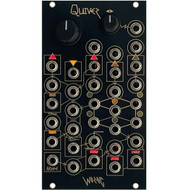
With thirty-four jacks, only two knobs, and very little text, Quiver at first look is perplexing. But little by little, taking time to actually look at the graphics while referencing the manual, doing some actual patching/testing, and showing the tiniest bit of patience, and Quiver's operation opened up and brought me in. In short, don't read a module by its faceplate (but do read the manual!). Ultimately, Quiver proves to be in perfect alignment with how WORNG does things, and its aesthetic is fits right in—in every way—with WORNG'S other modules perfectly.
Circles or squares surrounding jacks signify inputs and outputs respectively, and arrows pointing from one jack/section/utility to another show signal flow. There are some light up panels throughout that show voltage strength and polarity, and sometimes function as well, as is the case for the S&H output, but there are few words on the module to lend a helping hand. You really need to know what the symbols mean (rectifier, S&H), which isn't too hard, really, but still…you'd be dismissed for not wanting to put in the time. And yet, dismiss Quiver, and it's at your own cost, because it's more than just a mysterious looking utility module, and surprisingly more than just the sum of its offerings. As is usual for WORNG modules, it offers its own take on familiar synth tropes in dynamic fashion.
The four bipolar analog LFOs in Quiver are co-joined by the two knobs (the large is Rate, the small knob is a Rate Macro control). The leftmost LFO, the "Leader" (as per WORNG's terminology in the Quiver manual) is the main/fastest LFO (33ms to 1min), and this LFO contains a connected filtered and inverted output, which softens and gets smaller in amplitude as the frequency increases. The other three LFOs (designated as Followers A, B, and C) are still mostly controlled by the Rate knob, and are all related/clock divided by the leader, and they move at slower rates, getting slower with each successive LFO, with the overall movement of the three being further determined by the Rate macro controller, though as each also has a CV input to interact with the Rate controls, they can also go off on their own. A common theme with Quiver is the normalization/signal flow and the interaction thereof, and in the LFO portion of Quiver, if the Follower LFO CV inputs for any are unpatched, each LFO effects the next in line, concluding in some interesting cross modulation. Quiver isn't quite as obvious with its intent and operation as some other, more fully featured LFO modules that contain screens, various modes, etc., but its slight added element of related randomness gives it a surprising, musical factor that is inherent to its design. I've long loved dialing up related modulation in various dedicated LFO modules (the Xaoc Batumi and Five12's QV-L come to mind), that are fast and easy to configure, as well as easy to understand in terms of speed, positioning, etc., but the fast patching of the LFO section in Quiver, along with the fixed-ish operation of it makes for a quick and inspiring workflow, and different than any of the other LFOs I've used, especially when you get deep into patching it up.
The LFO section is the heart of Quiver, where everything starts, and its movement has a hand in shaping the other parts of the entire module, unless you cut out various normalization points by patching. Following the signal flow, the Leader LFO's wave is normalled to a small, three-jack wavefolder section where any two inputs are folded together. Again, this normalization can be broken, but with a single patch into the input of this section, a folded wave you shall receive at the output. There's a small backlit panel with a somewhat universal wavefolding symbol (think shrugging shoulders emoji, sans head) so you can see the voltage level coming out of the output. This folding action happens at the zero point, so there are no negative voltages occurring, which brings us to another related section in Quiver, a useful full-wave rectifier. While this is also for the folding of waves, it only folds a single wave, again at the zero point, so that it takes all negative voltage and turns it positive.
Quiver offers up some other handy tools; a white noise output, and further down the line, a voltage comparator that's normalled to both the Cube (top left output normalled to the comparator's positive input) and full-wave rectifier (the output is normalled to the comparator's negative input), so that, again, with no additional patching, another module-related modulating modulation source is available. Again, you can break the normaliza…
Following the signal path some more, the output of the comparator is normalled to the clock input of a sample & hold, while the white noise output is normalled to the signal input of the S&H. Again, with no additional patching…You're probably getting the idea.
There's also a Min/Max output, which follows suit and operation of the previous sections, and the other main mass of Quiver, which I've saved for last, is the cube-shaped, scaled-down, output modulation section taken from WORNG's Vector Space, itself an incredibly interesting and useful module. Taking the three LFO Follower output voltages as its inputs, Cube offers up six random modulation outputs without needing any additional inputs than are already available.
Quiver's potential use list is quite large. At one extreme, using the entirety of the modulation possibilities on part of a patch can be interesting, if not overwhelming. Since you can clock Quiver, and normalization flows throughout it, rhythm related modulation can be had in maximum capacity! Setting up a very basic subtractive patch (2 x VCOs-mixer-VCF-ENV-VCA), and starting with only a melody taken from Floating Knob's Cuisine sequencer, patched into both VCO's 1v/Oct inputs, I started patching modulation from Quiver into the CV inputs on the various modules. This was mostly a typical patching experience, starting with the LFOs, until I got to a point where the modulation became pretty dense and I had to listen carefully each time new modulation was introduced. It's strange how nuance becomes more important as sheer complexity—or even just more of something—is introduced.
It's easy to find uses for all of the modulation opportunities here, but especially interesting was the Cube's outputs. I'd sort of saved them towards the end of my patch experiment so that I could hear the various modulation outputs and try to discern the relationship between them. It was a lesson in strict, hard, deep listening, and trying to understand what was happening, how the modulation was related to the internal clock definitely presented a challenge at times. Granted, all of my deciphering (hits and misses) didn't matter to the movement of the sound in terms of dynamics, and how much Quiver offers in this way became even more valuable and evident when I moved off of my simple self-imposed patch structure and started moving modulation all around my rig. Nothing is off the table here, as there are plenty of modulation opportunities. It was really rewarding to patch up a three-channel drum voice (Modbap's Trinity, in this case) using just the six available Cube outputs. Rhythms I would not have come up with, that's for sure, popped up all over the place, and tweaking the Rate and modulating the Rate Macro further jumbled my drums.
Self-patching Quiver, while reducing the number of modulation available (unless you do some multing), brings on more complex modulation, and while they might still be related in some mathematical or theoretical way, it was hard to tell most of the time. This complexity created additional movement, organic and oft surprising. Not that there was any shortage of this to begin with, but with self patching, it was only more so.
Quiver offers a bevy of tried and true synth standard modulation tools, one absolutely not-so-standard one (the Cube), all while doing so in a very WORNG, though very right, and definitely unique way.
Price: $349